Monday, 17 December 2012

Spend or Send


Spend or Send

FINANCE & DEVELOPMENT, December 2012, Vol. 49, No. 4
Developing countries can spend commodity windfalls on physical investment, but it may be better in the short run to distribute part of them to their citizens
THE decade-long boom in commodity prices has boosted government coffers in many traditional producing countries. Following a wave of discoveries, new oil and gas producers—such as Ghana, Mozambique, Tanzania, and Uganda—are also emerging (see table). They may not all be major players at the global level, but the revenues they raise will be substantial for them and will brighten the prospects for growth and poverty reduction.
Still, the future is not without its dark side. New oil income will almost certainly relax constraints on government budgets, but it will also create challenges—as conditions in other resource-rich countries show. Many citizens of these countries remain poor, despite large revenues from resources. In some cases competition over resource wealth
The big payoffhas fueled or sustained civil conflict. Economic diversification is a further long-run challenge: nonresource sectors tend to lose competitiveness as a result of exchange rate appreciation.
All of these effects have been seen, for example, in Nigeria in past years. The long-run issues surrounding development become starker in light of the need to rebalance economies by fostering non-commodity-based industries to produce higher-value-added goods and provide a livelihood for people after commodity reserves are depleted. Advanced economies have moved away from natural capital—such as oil and gas deposits and mineral reserves—to physical and human capital (see Chart 1). But the wealth of poor countries tends to be concentrated in natural resources.
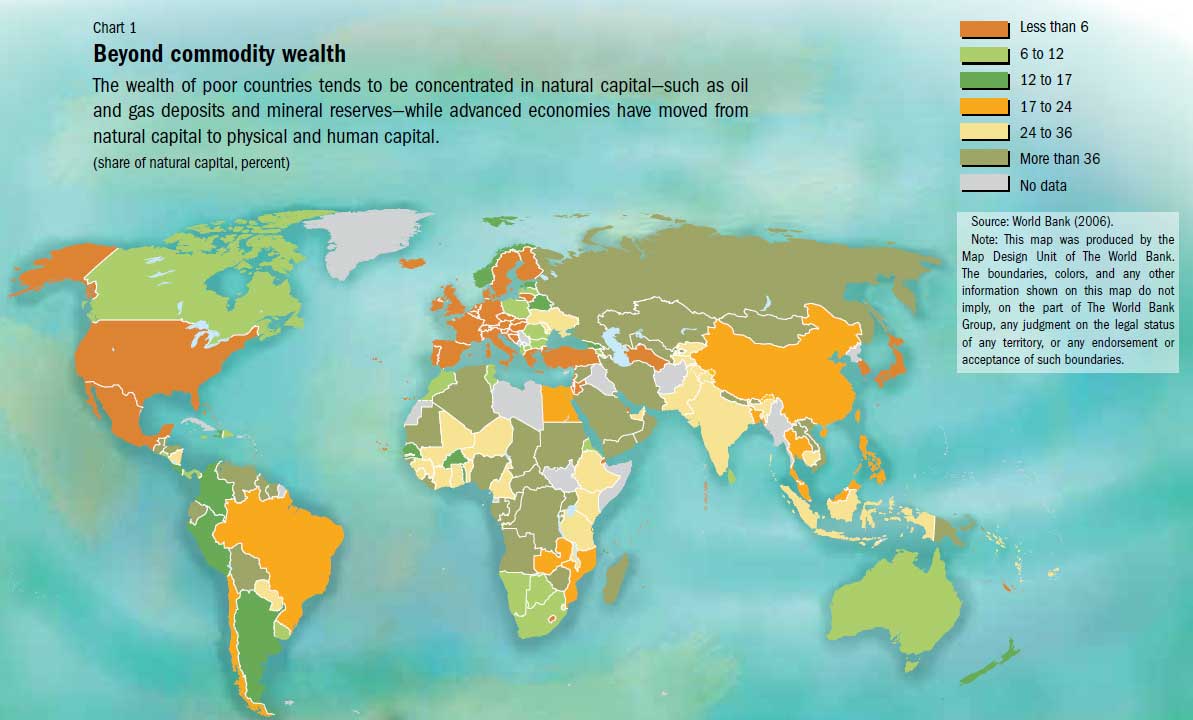
Click to enlarge the chart
The traditional argument is that countries should use their resource revenues to finance public investment. But there are questions about whether this is always the best approach. The limited state capacity of many resource-based countries makes appropriate and effective investment difficult to achieve. Limited capacity reflects not only a government’s lack of technical ability to identify, implement, and monitor key investment projects. It is often also the result of public sector corruption that allows those with clout to misspend and misallocate the resource windfall, including through high-value construction contracts that are especially susceptible to mismanagement. As a result, in some cases sharply scaled-up public investment may be the wrong way to go. It may be more effective in the short run to distribute some of the windfall as a direct dividend to citizens and rely on their spending choices to create and foster nonresource industries. In the medium and long run, countries should beef up their governing capacity—investing in investment capacity, so to speak—to relax some of the constraints on the use of revenues.

Avoiding past mistakes

During the booms of the 1970s, many traditional commodity exporters embarked on ambitious, but often wasteful, public spending—including on infrastructure such as roads, ports, and railroads. Case studies document investment projects that were plagued by inefficiency and also contributed to resource misallocation (Gelb, 1988). Even when completed, large projects sometimes failed to provide benefits because governments were unable to cover the high costs of operating and maintaining them.
Commodity windfalls, because they move directly through government coffers, offer public officials ample opportunity to divert them for personal gain. Manipulation of public spending, especially in the letting of construction contracts, is a major impediment to the successful use of windfalls. A study of 30 oil-exporting countries for the period 1992–2005 shows that large oil windfalls cause a significant increase in corruption (Arezki and Brückner, 2012); this both raises the cost of public investment and reduces its quality. An index of the quality of public investment management produced by the IMF shows markedly lower quality in resource-exporting countries (Kyobe and others, 2011). In addition, spending booms triggered by oil revenues have often overshot available resources and led producing countries, especially those with weak institutions, to fall into debt (Arezki and Brückner, 2011).
Click to view the larger chart
To avoid such problems, commodity producers must take into account their institutional conditions when determining the long-term level and type of spending following a commodity windfall. We can model optimal spending decisions for countries with weak governing capacity by assuming that there are inefficiencies—due to poor governance and public institutions—that make the costs of public investment exceed its face value, and we can assume that those costs increase with the size of the commodity windfall. We can also consider the implications of a better or worse investment climate faced by private businesses, which will affect how strongly private investment responds to the opportunities created by public infrastructure spending. Different countries face different combinations of these two institutional conditions (see Chart 2). Some may have a relatively strong public administration but a poor business climate (for example, Algeria), while others with relatively low scores on perceived quality of state institutions manage to sustain quite an efficient private sector (for example, Kenya). We also consider an alternative to public spending: the direct transfer of windfall resource revenues to citizens to supplement their wage income and raise their opportunity to invest and consume.

Citizen gain

The direct transfer of resource windfalls to citizens has been done. The U.S. state of Alaska and the Canadian province of Alberta send their citizens a yearly payment based on oil revenue. Each Alaska resident, for example, received a dividend of about $1,300 in 2009 (Ross, forthcoming). Mongolia distributes part of its mining revenues to its citizens and has recently pledged to endow each Mongolian with a portfolio of dividend-yielding preference mining shares. One argument for citizen dividends draws on evidence that taxation has historically been central to the creation of effective modern states: by distributing resource revenues and then taxing back part of them governments improve public accountability because citizens are more inclined to monitor the use of public funds (Sala-i-Martin and Subramanian, 2003; Moss, 2011). More direct arguments relate to the observed inefficiency in public spending, especially as programs are scaled up, and the frequent failure of ordinary people to benefit from the scaled-up public spending programs. Still more immediate arguments relate to increasing evidence of the development impact of cash transfers and the possibility of making them effectively.
Social transfers work and are one of the most effective—and evaluated—mechanisms of development assistance, especially when those transfers are conditioned on actions by recipients—such as keeping children in school. Many studies document how such transfers help households reduce poverty and improve children’s growth indicators, encourage school attendance, and improve access to health services. There is also little evidence that transfers to poor people discourage people from working. On the contrary, recipients seem to use the money to search for jobs. Moreover, transfers appear to encourage productive household activity. Poor households are less constrained by the deficient credit and insurance markets that characterize less developed economies. Small but reliable flows of transfers have helped poor households accumulate private productive assets, avoid distress sales in bad times, obtain access to credit on better terms, and diversify into higher-risk and higher-return activities. There is also some evidence that the introduction of transfers into poor remote areas can stimulate demand and local market development. Transfers are increasingly being integrated into social protection programs. Evidence from many social programs suggests that resource-generated transfers can help both recipient households and the country.
Not long ago, it would have been difficult, if not impossible, to send a windfall dividend to citizens in poorer countries without much of it being lost or appropriated by corrupt civil servants. But new technology has opened up ways to transfer funds accurately and efficiently to households—and at low cost. Cellular phones and biometric smartcards are increasingly being used, even in countries with poor institutions and low capacity. For example, Pakistan’s Watan Card program delivered reconstruction support to more than 1.5 million flood-affected households. South Africa’s system of social grants effectively uses this technology, as does a program to support demobilized militias in the Democratic Republic of the Congo. Biometric technology can overcome traditional difficulties in identifying recipients, preventing multiple payments, and eliminating “ghost” recipients. Gelb and Decker (2012) consider 19 programs. Not all programs have been comprehensively evaluated, but the evidence indicates that they can be implemented on a large scale with nearly all funds going for their intended use (“little leakage,” in economic parlance), using identification and payment technologies that provide benefits beyond the transfer program itself—such as access to a bank account for precautionary savings and fuller and accurate electoral rolls. Because these technologies can minimize the costs of distributing an oil dividend uniformly across the population, it is reasonable to assume that policymakers can use part of a commodity windfall to provide direct transfers at essentially zero cost.

What to do

Considering all these elements in a model of optimal windfall use leads to a number of conclusions that can help guide policy. All decisions should of course be made in a long-run context that encourages saving when resource income is high to enable spending to continue when that income is low. But beyond these considerations, institutional features shape how the windfall could best be used. Weaker public administrative capacity reduces the optimal level of public investment in favor of larger transfers to citizens: it is better to give private households part of the funds directly than to waste them on ineffective spending. Moreover, all else equal, a larger commodity windfall should induce lower rather than higher public investment, because the behavior of officials seeking to appropriate the windfall further weakens the country’s capacity. These conditions bolster the argument for transfers to citizens.
The underlying business climate also plays a role in determining the optimal use of resource revenues. Good conditions—such as security and stable pro-business regulations that encourage the private sector—may compensate for weak capacity and justify higher public investment. This is because public investment spending is likely to encourage more productive private investment, which in effect raises the return on the public investment. Government capacity may affect the business climate, but good governance and a good business climate do not always go hand in hand, as we show in our examples above. Commodity-producing governments and their strategic economic advisors must take these institutional factors into account when determining how to use their revenues.

Investing in investing

Limited government capacity is a constraint, but not necessarily a fixed one. Some countries—Chile, for example—have strengthened their capacity; others have arguably weakened it. A windfall might well be spent in part on improving a country’s capacity to manage its investment program and provide the key public goods and services—such as effective roads, power supply, and regulation—the private sector needs to thrive. To explore such a possibility we extended our basic model by introducing the possibility of reducing the adjustment cost in public investment over time—at a price. We found that optimal public investment increases over time, with reliance on transfers diminishing as ever-increasing public capital attracts more private capital and produces more wage income. In general, the better the business climate, the stronger the arguments for this strategy. There is less point in boosting public investment if it then fails to stimulate private investment to produce valuable output. More research is needed on modeling state capacity, ways to invest in that capacity, and the time frames for such improvement.
To combat corruption, commodity exporters could ensure better transparency in the handling of windfalls. For instance, the Extractive Industries Transparency Initiative provides a global standard for transparency in the oil, gas, and mining industries, while the Natural Resource Charter, which builds on the transparency initiative, offers more comprehensive principles for governments and societies on how to best harness the opportunities for development generated by extractive commodity windfalls. Those initiatives can serve as anchors for enhancing transparency and accountability in commodity-rich countries. More specifically, open publication of public procurement contracts can help improve investment quality and reduce contract costs and cost overruns (Kenny and Karver, 2012).
Countries can also boost their technical ability to identify and implement projects. An example is Chile, which for three decades has subjected all public projects to disciplined and transparent cost-benefit analysis. The South American nation standardized the approach to evaluating a project and separated the institution that evaluates a project from the one proposing it. The National System of Investments is based at the Ministry of Planning and is administered jointly with the Ministry of Finance. A combination of efforts to increase technical capacity and eradicate corruption is the best way to harness the power of commodity windfalls in developing countries. ­■
Rabah Arezki is an Economist in the IMF Institute for Capacity Development, Arnaud Dupuy is Professor of Economics at the Reims Management School, and Alan Gelb is Senior Fellow at the Center for Global Development.
This article is based on the authors’ IMF Working Paper 12/200, “Resource Windfalls, Optimal Public Investment, and Redistribution: The Role of Total Factor Productivity and Administrative Capacity.”

References

Arezki, Rabah, and Markus Brückner, 2011, “Oil Rents, Corruption, and State Stability: Evidence from Panel Data Regressions,” European Economic Review, Vol. 55, No. 7, pp. 955–63.
———, 2012, “Commodity Windfalls, Democracy and External Debt,” Economic Journal, Vol. 122, No. 6, pp. 848–66.
Gelb, Alan, and associates, 1988, Oil Windfalls: Blessing or Curse? (New York: World Bank/Oxford University Press).
Gelb, Alan, and Caroline Decker, 2012, “Cash at Your Fingertips: Biometric Technology for Transfers in Developing Countries,” Review of Policy Research, Vol. 29, No. 1, pp. 91–117.
Heston, Alan, Robert Summers and Bettina Aten, 2006, Penn World Table Version 6.2,Center for International Comparisons of Production, Income and Prices at the University of Pennsylvania (Philadelphia).
Kenny, Charles, and Jonathan Karver, 2012, “Publish What You Buy: The Case for Routine Publication of Government Contracts,” CGD Policy Paper 011 (Washington: Center for Global Development).
Kyobe, Annette J., Jim Brumby, Zac Mills, Era Dabla-Norris, and Chris Papageorgiou, 2011, “Investing in Public Investment: An Index of Public Investment Efficiency,” IMF Working Paper 11/37 (Washington: International Monetary Fund).
Moss, Todd, 2011, “Oil to Cash: Fighting the Resource Curse through Cash Transfers,” CGD Working Paper 237 (Washington: Center for Global Development).
Ross, Michael L., forthcoming, “The Political Economy of Petroleum Wealth in Low-Income Countries: Some Policy Alternatives,” in Commodity Prices and Inclusive Growth in Low-Income Countries, ed. by Rabah Arezki, Catherine Pattillo, Marc Quintyn, and Min Zhu (Washington: International Monetary Fund).
Sala-i-Martin, Xavier, and Arvind Subramanian, 2003, “Addressing the Natural Resource Curse: An Illustration from Nigeria,” IMF Working Paper 03/139 (Washington: International Monetary Fund).
World Bank, 2006, Where Is the Wealth of Nations? (Washington).
———, 2011, World Development Indicators (Washington).

Tuesday, 11 December 2012

Unitary taxation one way to tackle multinationals


Unitary taxation one way to tackle multinationals


KATIE WALSH
Members of the federal government’s latest tax review say there are no easy answers to the global phenomenon of multinationals paying little tax, and a solution could take years.
Assistant Treasurer David Bradbury appointed the 14 members of the panel on Monday, part of his offensive against multinationals – including Google and Apple – that do not pay their “fair share” of tax.
“To address this problem is going to require a long and sustained effort,” said the Tax Justice Network’s Mark Zirnsak, one of the 14 members of the tax panel.
“I don’t have ­expectations that we’ll do work over the next year and all of a sudden this problem of companies shifting profits across borders is going to be fixed.”
Dr Zirnsak will argue for a switch to unitary taxation: allocating global profits of a business based on their economic presence in each country – the number of staff, physical assets and sales made.
“[It] makes it harder for a company to set up a headquarters in Bermuda and say all the profits are made in Bermuda,” said Dr Zirnsak, who is also Uniting Church director of the justice and international mission.
The Tax Justice Network – whose Australian members include unions and charities – released its blueprint for such a global tax model on Sunday, calling on the OECD to abandon outdated transfer pricing methods that apportion tax based on arm’s length transactions.
A similar system operates in the United States, between the states.
He said he would also table ideas to increase exchanges of information between countries and introduce whistleblowing laws to help staff to dob in tax-evading companies.
Fellow panellist Clayton Utz partner Niv Tadmore said that the group could explore an option to charge a withholding tax on sales made in Australia, where companies could lodge final year-end returns.
Corporate Tax Association executive director Frank Drenth said that a withholding tax would probably be passed on to consumers and businesses. Another option was a minimum tax, like that in the US which applies to companies that report tax income dramatically lower than their accounting income.
But unlike in the US, there were few “rorts and concessions” left in Australia that needed a minimum tax fix, Mr Drenth said.
The panel’s response might involve a mix of measures, he said, including longer-term bilateral agreements. “I’ve genuinely got an open mind on it, but we’d want any solution to be practical and workable rather than just ­theoretical,” he said.
Digital companies like Google that are causing governments around the globe grief over lost revenue are not on the panel. But their advisers are, says panellist Tim Lyons, Australian Council of Trade Unions assistant secretary. That includes partners from PwC, Deloitte, Ernst & Young and Clayton Utz.
Mr Lyons applauded the wide selection of people on the panel and said it was important to have an open mind.
“Short term fixes are okay in one sense, but the issues of the potential for there to be profitable arbitrage are not going away,” he said.
“What I’m interested in contributing to is something where we actually get our domestic settings right, and hopefully we have a few allies overseas [for a longer-term solution],” he said.
Low tax-paying multinationals are facing heat worldwide. Last week, Starbucks announced it would voluntarily pay £20 million ($30 million) in tax, as protesters prepared UK-wide action.
“It reminds me of [US presidential candidate] Mitt Romney offering to pay a little bit more tax so that his underlying rate looked a bit better,” said Mr Lyons. “Tax isn’t charity. The fact that you’ve got somebody saying ‘I’m going to volunteer to pay more tax’ shows you there’s something wrong with the tax system.”
Mr Drenth said Starbucks’ move was unprecedented on the tax front, but was in some ways similar to payments made by mining companies to aggrieved landholders.
Members of the specialist reference group:
■ Rob Heferen (Chairman), Executive Director, Revenue Group, The Treasury
■ Michael Bersten, Partner, PwC
■ Michael D’Ascenzo AO Commissioner of Taxation (2006 – 2012)
■ Frank Drenth, Executive Director, Corporate Tax Association of Australia
■ Serena Lillywhite, Mining Advocacy Coordinator, OxFam Australia
■ Ross Lyons, General Manager – Tax, Asia Pacific, Rio Tinto
■ Tim Lyons, Assistant Secretary, ACTU
■ Peter Madden, Partner, Deloitte
■ Jason Sharman, Director, Centre for Governance and Public Policy, Griffith University
■ Greg Smith, Adjunct Professor, Australian Catholic University, Senior Fellow, The Melbourne Law Masters
■ Tony Stolarek, Partner, Ernst & Young
■ Niv Tadmore, Partner, Clayton Utz
■ Brian Wilson, Chairman, Foreign Investment Review Board
■ Mark Zirnsak, Director, Justice and International Mission Unit, Uniting Church
The Australian Financial Review

Monday, 10 December 2012

Google Revenues Sheltered in No-Tax Bermuda Soar to $10 Billion

Google Revenues Sheltered in No-Tax Bermuda Soar to $10 Billion


Google Inc. (GOOG) avoided about $2 billion in worldwide income taxes in 2011 by shifting $9.8 billion in revenues into a Bermuda shell company, almost double the total from three years before, filings show.
By legally funneling profits from overseas subsidiaries into Bermuda, which doesn’t have a corporate income tax, Google cut its overall tax rate almost in half. The amount moved to Bermuda is equivalent to about 80 percent of Google’s total pretax profit in 2011.
Google Inc. logos are displayed for a photograph. Photographer: Andrew Harrer/Bloomberg
The increase in Google’s revenues routed to Bermuda, disclosed in a Nov. 21 filing by a subsidiary in the Netherlands, could fuel the outrage spreading across Europe and in the U.S. over corporate tax dodging. Governments in France, the U.K.,Italy and Australia are probing Google’s tax avoidance as they seek to boost revenue during economic doldrums.
Last week, the European Union’s executive body, the European Commission, advised member states to create blacklists of tax havens and adopt anti-abuse rules. Tax evasion and avoidance, which cost the EU 1 trillion euros ($1.3 trillion) a year, are “scandalous” and “an attack on the fundamental principle of fairness,” Algirdas Semeta, the EC’s commissioner for taxation, said at a press conference in Brussels.

‘Deep Embarrassment’

“The tax strategy of Google and other multinationals is a deep embarrassment to governments around Europe,” said Richard Murphy, an accountant and director of Tax Research LLP in Norfolk, England. “The political awareness now being created in the U.K., and to a lesser degree elsewhere in Europe, is: It’s us or them. People understand that if Google doesn’t pay, somebody else has to pay or services get cut.”
Google said it complies with all tax rules, and its investment in various European countries helps their economies. In the U.K., “we also employ over 2,000 people, help hundreds of thousands of businesses to grow online, and invest millions supporting new tech businesses in East London,” the Mountain View, California-based company said in a statement.
The Internet search giant has avoided billions of dollars in income taxes around the world using a pair of tax shelter strategies known as the Double Irish and Dutch Sandwich, Bloomberg News reported in 2010. The tactics, permitted under tax law in the U.S. and elsewhere, move royalty payments from subsidiaries in Ireland and the Netherlands to a Bermuda unit headquartered in a local law firm.
Last year, Google reported a tax rate of just 3.2 percent on the profit it said was earned overseas, even as most of its foreign sales were in European countries with corporate income tax rates ranging from 26 percent to 34 percent.

Foreign Taxes

At a hearing last month in the U.K., members of Parliament pressed executives from Google, Seattle-based Amazon.com Inc. (AMZN) and Starbucks Corp. (SBUX) to explain why they don’t pay more taxes there.
The U.K., Google’s second-biggest market, was responsible for about 11 percent of its sales, or almost $4.1 billion last year, according to company filings. Google paid 6 million pounds ($9.6 million) in U.K. income taxes.
Matt Brittin, Google’s vice president for Northern and Central Europe, testified that the company pays taxes where it creates “economic value,” primarily the U.S.
Still, Google attributes some profit based on technology created in the U.S. to offshore subsidiaries, lowering its U.S. taxes, according to company filings and people familiar with its tax planning. Google paid $1.5 billion in income taxes worldwide in 2011.

‘Fair Share’

In the wake of the parliamentary hearing, the House of Commons issued a report last week declaring that multinationals “do not pay their fair share” of tax. The committee also criticized the U.K.’s tax collection agency, Her Majesty’s Revenue & Customs, for “not taking sufficiently aggressive action” and called on the agency to “get a grip” on corporate tax avoidance.
A spokesman for HMRC said the agency “ensures that multinationals pay the tax due in accordance with U.K. tax law.”
The French tax authority this year proposed increasing Google’s income taxes by about $1.3 billion. The agency searched Google’s Paris offices in June 2011 and removed computer files as part of an examination first reported by Bloomberg last year. Google is cooperating with French authorities and works with them “to answer all their questions on Google France and our service,” the company said.

Italian Audit

In Italy, the Tax Police began an audit of Google last month and recently searched the company’s Milan offices, as well as the offices of Facebook Inc. (FB), according to a person familiar with the matter. “It’s very common for companies to be audited, and we have been working closely with the Italian authorities for some time,” Google said. “So far we have not had any demands for additional tax in Italy.”
Facebook, based in Menlo Park, California, is cooperating with the Italian tax authority and “we take our obligations under the Italian tax code very seriously,” a company spokeswoman said.
In Australia, the country’s assistant treasurer gave a speech last month outlining Google’s tax avoidance strategies.
The use of offshore shelters to avoid corporate taxes has prompted calls for reform in the U.S. as well. The Treasury Department has repeatedly proposed since 2009, with little success, to make it harder for multinationals to bypass taxes by shifting profit into tax havens.

Transfer Pricing

Multinational companies cut their tax bills using “transfer pricing,” paper transactions among corporate subsidiaries that allow for allocating income to tax havens and expenses to higher-tax countries.
In Google’s case, an Irish subsidiary collects revenues from ads sold in countries like the U.K. and France. That Irish unit in turn pays royalties to another Irish subsidiary, whose legal residence for tax purposes is in Bermuda.
The pair of Irish units gives rise to the nickname “Double Irish.” To avoid an Irish withholding tax, Google channeled the payments to Bermuda through a subsidiary in the Netherlands -- thus the “Dutch Sandwich” label. The Netherlands subsidiary has no employees.
The Dutch unit’s payments to the Bermuda entity last year were up 81 percent to $9.8 billion from $5.4 billion in 2008. Google’s overseas sales have increased at about the same rate.
Google’s overall effective tax rate dropped to 21 percent last year from about 28 percent in 2008. That compares with the average combined U.S. and state statutory rate of about 39 percent.
To contact the reporter on this story: Jesse Drucker in Rome at jdrucker4@bloomberg.net
To contact the editor responsible for this story: Daniel Golden in Boston atdlgolden@bloomberg.net

Wednesday, 5 December 2012

Introducing the Rules


Dear friends,

Introducing The Rules

We’d like to introduce you to /The Rules, a new global movement to change the rules that create inequality and poverty around the world.

Our launch campaign aims to highlight the systemic damage caused by tax havens and focuses on the City of London as the center of the web. We’d like you to be among the first to participate:

Dear UK: Stop stealing the world’s wealth
Tax havens are hiding over 21 trillion US dollars from governments and the public around the world. UK Prime Minister David Cameron has the chance to deal a powerful blow to this corrupt system but without public pressure, the loudest voices he will hear are those of the powerful financial sector. It will take a massive global show of outrage but with your help our voices can drown out the big banks, and strike at the heart of the global tax haven network.

We’ve also published a kickoff article in Al Jazeera, which we hope you will read and share widely with your networks.

Please contact us at info@therules.org if you have any feedback, especially as it relates to our launch campaign.

Let’s work together to change the rules! And that’s how we’ll start to change the world…

Thank you,
/The Rules team

@therulesorg

We have the power to change the rules

We have the power to change the rules

Tax havens are allowing a "tiny global elite" to "extract trillions of dollars" from rich and poor countries alike

The ancient Mayan civilisation's Long Count calendar ends in December 2012. This fact has sparked debate in recent years about whether our generation was the one that would experience humanity's final days. Whatever your reading of that debate, you certainly don't need to look far today for evidence that the human race is in serious trouble. But amidst all the grim realities, there are also significant signs of hope: signs pointing to new opportunities for positive, lasting change.
In recent years, we saw dictatorships toppled across North Africa and the Middle East. There was hope that nations could chart a common course to tackle climate change. We seemed on the verge of reining in the unchecked greed of the banking system. Back in 2008, America surprised the world by electing a black president to the White House.
Yet cynicism can so quickly fill the space where hope had bloomed. In nations where dictators were toppled, old elites reassert their power. Today, while the warming oceans rise, even the prospect of a global climate plan is beyond the horizon. While there are fewer banks now, they are richer and more powerful than ever before. A black president has been re-elected, but financial elites have never had more of a stranglehold on American priorities.
The greatest hope for progress on such vast challenges is in the democratic impulse now taking shape in many nations. Coordinated movements of ordinary citizens have emerged as a major force from Tahrir Square to Wall Street. Across the world we are seeing millions of ordinary people joining citizen-powered movements, determined to overwhelm the power of entrenched elites. They are harnessing new technologies and social networks and seeing themselves as the agents of change. These movements are still half-formed and often flawed, but they are getting stronger.
Changing the rules
The challenge now is for these new movements to grow, to work together and to focus their energies. Lasting change requires more than overthrowing a dictator or firing a few CEOs. It requires changing the rules themselves - the national and international laws, policies and practices that allow injustices to endure while regimes rise and fall.
The rules as they stand today have created a world in which inequality is vast and growing. The world's 1,226 billionaires have more combined wealth than 3.5 billion people - half the entire planet's population. The richest 10 per cent of the world's population takes 90 per cent of the world's income.
"The world's 1,226 billionaires have more combined wealth than 3.5 billion people - half the entire planet's population."

The scale of inequality and poverty can appear overwhelming and unchangeable. Yet it is not inevitable. It is the outcome of active choices by people who make and enforce the rules we all live by: rules about global trade, banking, loans, investment, taxes, working conditions, land, food, health and education. These rules are made by people and people can change them.
Frederick Douglass, a leader of the 19th century abolitionist movement which brought an end to slavery, once said, "Power concedes nothing without a demand". If we want to change rules that have been written by the few and for the few, we must look outside existing power structures to the power of the many. We know from history that when people demand their rights, they can move mountains and change whole systems.

Right now, there is a special moment of opportunity. Throughout the world, citizens have access to information in ways once unimaginable. Affordable technologies are revolutionising our ability to communicate with one another and act collectively. The opportunities for new citizen-powered movements to become catalysts for change have never been greater than today. Powerful elites are losing the structural advantages they once enjoyed of being able to maintain secrecy, restrict information and suppress popular movements.
Offshore tax havens
This month, we are launching a new platform called /The Rules, to help mobilise action by ordinary citizens around the world to challenge and change the rules - the most basic drivers of inequality and poverty. We have a special focus on organising with people and grassroots movements in countries such as Brazil, India, Kenya and South Africa. We are creating new ways for people to speak up using simple, cheap technologies like basic mobile phones.

The first campaign for /The Rules will target the system of offshore tax havens, starting with one of the biggest and most connected of all, the City of London. Tax havens are the product of rules that have been rigged by powerful corporations, lobbyists, lawyers, bankers, accountants and government officials. They are allowing a tiny global elite to extract trillions of dollars from rich and poor countries alike, starving our nations' treasuries and choking off funds essential for schools, medicines, social programmes and infrastructure.
New research has blown the lid on this secretive shadow economy, with at least $21 trillion estimated to have been stowed away in these tax havens - 10 per cent of all the world's privately held wealth. This is also more than 10 times the total value of development aid given to the world's poorer nations in the past 20 years. The few who benefit from these rigged rules will fight long and hard to preserve them, but they can be defeated.
Rules express and entrench much of the injustice in our world today. But rules can be changed and the opportunity to make those changes has never been greater. Instruments of power once only in the hands of elites are now available to ordinary citizens - and we are beginning to use them. That gives us reason for hope.
This article was written by founding members of /The Rules, including:
Alnoor Ladha is an activist and social entrepreneur. He is a co-founder of /The Rules, a citizen powered movement to address the root causes of poverty and inequality. He is also a Partner and the Head of Strategy at Purpose, an incubator for new types of social movements, and currently a Board Member of Greenpeace International USA.
Follow him on Twitter: @alnoorladha
Firoze Manji is the founder and former editor-in-chief of Pambazuka News and founder and former executive director of Fahamu - Networks for Social Justice. He is a visiting fellow at Kellogg College, University of Oxford, and an associate fellow of the Institute for Policy Studies, Washington.
Follow him on Twitter: @firozem
Thomas Pogge is Leitner Professor of Philosophy and International Affairs at Yale. He is President of Academics Stand Against Poverty (ASAP), an international network aiming to enhance the impact of scholars, teachers and students on global poverty. Having received his PhD in philosophy from Harvard, Pogge is also involved in a team effort toward developing a complement to the pharmaceutical patent regime that would improve access to advanced medicines for poor patients worldwide.
The views expressed in this article are the author's own and do not necessarily reflect Al Jazeera's editorial policy.
Source:
Al Jazeera
http://www.aljazeera.com/indepth/opinion/2012/11/20121126134721926547.html

Join the Afritax Google Group Today


Join the Afritax Google Group Today

For the latest updates in taxation, the extractives industry and economic justice issues, subscribe to the Afritax Google group.

This is the mailing list for Tax Justice Network-Africa (TJN-A).
Afritax aims to facilitate discussion on Taxation in Africa by encouraging debate on sustainable development through pro poor Tax policies, highlighting the links between Tax policies and Development in Africa, and tackling of harmful Tax practice that encourage resource outflow from the continent.
You are most welcome to send posts and participate in discussions.
You can view previous posts on the group by following this linkhttps://groups.google.com/group/afritax
View our website http://www.taxjusticeafrica.net/

Uncovering the secrets of international finance: Tax Havens


Tax Havens - Investigating International Finance - Episode 1

This is the first in a series of 4 videos investigating different areas of the international finance system. Each is a short introduction to a major challenge we face if we want to reform global finance and make it work for people and the planet. Millions of individuals have been adversely affected by the risky practices of financial institutions, but their operations remain shrouded in mystery. This is one of the biggest barriers to reforming global finance – not enough people understand how it works. 
Today's first film focuses on tax havens. Used by wealthy individuals and comhttp://www.youtube.com/watch?v=3I-RVVa6mKcpanies to shift huge sums of money around the world in secret, they cost governments and ordinary taxpayers billions of pounds. International efforts to tackle tax havens to date have been feeble, but there is no reason why proper action can't be taken - watch the video to find out what can be done.

The last few years have shown what can happen when the finance system goes wrong - to ensure global financial stability, now is the time to expose the system's murky secrets.